
Analogue Holidays

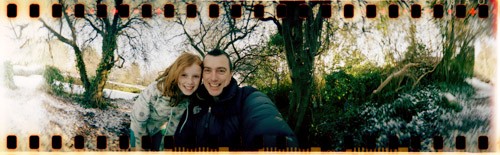
The Lomography Spinner 360 at work

We all need a break.  You’d think that I’d take a break from taking pictures over the holidays wouldn’t you?  Well, no.  I usually take the opportunity over the hols to shoot some film.  Yes, film.  Old school stuff.  But I find the practice of shooting film slows me down and forces me to take more time over taking a picture which is no bad thing.

So I smiled to myself packing my extra ‘take home for the hols’ bag on Christmas Eve:

  • My spare D700 to come home – not exactly state of the art anymore but it still takes stunning images in many very demanding conditions.
  • My ‘new’ Hasselblad 500C – the market seems to have fallen out of medium format on eBay recently and I picked one up for the experience of using a larger image circle.  Formerly the Pro Photographer’s Work Horse and still a lot of great glass and film area to play with.
  • My new Lomo Spinner 360 – how much fun can you have with a 35mm negative?  Regular readers will know I’m a Lomo fan and this was on special before Christmas.

We had a lot of fun with the spinner in the snow on Christmas Eve – some of them even came out!  Remember that ‘wait and see what you got’ feature that you have with film?

I ran my first ever 120 film through the ‘blad on New Year’s Day – need to find someone to develop it now!

If there’s a message from this then it’s to do some personal work as well as all that other stuff: have some fun and enjoy your cameras – all of them.  Each has its strengths and stretching your mind to use each for something different is good for your creativity.

Have a Happy New Year.  Be creative and make some time to enjoy yourself a little more than you did in 2010.
Digital Photography is free

I think we all still think of digital photography as being free.  The fact that we no longer have to pay for film, processing and printing every 36 frames makes us think that there is no cost to clicking away with our digital camera, phone or iPod.

But photography is certainly more expensive in the digital era.

Today I finally bit the bullet and ordered a new second hard drive for my main workstation.  The time taken to shuffle working files around to create space for new work was just getting too much.  Granted I took the old one from my old laptop so I can’t really complain

Now this drive is just for the ‘active’ images – those jobs where I’m still expecting print or album orders – the archive is separate (and I’m slowly filling that up too).

I remember doing a broad check on the cost of the pro-level Nikon SLRs back from the F4 days to current D3 generation.  I didn’t do a full NPV calculation but the cost of those bodies hasn’t changed an awful lot – of course you get a lot more technology for your money.

But now you need to add a whole lot of extra stuff to the cost of your pictures: computing power, storage, backup.

And in the end you’ll still have to print your best images if you really want to enjoy them at their best.

Digital Photography has changed the way we take pictures for ever.  Many of those changes are positive (and there are a few more subtle negative ones).  But you get nothing for nothing.

P is for Professional Photographer Mode

Its an old joke in the camera world: amongst the many modes your camera has are ‘A’ and ‘P’ – they stand for ‘Amateur’ and ‘Professional’ :o)

Well of course not really.  In fact quite the opposite.  ‘P’ is for Program Mode in which the camera makes all the decisions about everything and therefore gives the photographer no control.  At least in ‘A’ mode you get to choose your Aperture (‘A’ is for Aperture Priority BTW) so you control how much of your scene is in focus.

Teachers and Pro Photographers generally scorn Program Mode and I understand why.  Many courses will start you out with the most basic camera in Manual mode because it really is the best way to learn how photography works (because if you don’t get it right you don’t get a photograph).

This definitely works (although it can be frustrating for people used to instant success in a modern world).  I ‘grew up’ on manual cameras (mostly because as a student I couldn’t afford anything else).

But I don’t agree with the ‘you have to shoot Manual – always’ mantra that you pick up on a lot of the Fora.  Once you have the skills and experience (which you get from shooting manual) then your camera is a very functional tool with features to help you in many varied circumstances.

Moreover, these days they are very good at what they do: why not use the auto features if you can control them and predict what they’re going to do for you?

I use: autofocus 99% of the time – but I decide which focus point to use; auto ISO most of the time (it is an entirely predictable algorithm); Auto exposure – in Aperture Priority Mode – with a mix of metering patterns and manual compensation when it doesn’t quite give me what I want; and auto white balance sometimes does the job of tricky mixed lighting (and it can easily be changed afterwards).

Using these tools gives me a very high percentage of in-focus, well exposed images so that I can concentrate on my subject.

So, as usual, I think the right answer is ‘never say never’.  If you understand how a tool works, you can control it, you know its limitations and you know what to do when it isn’t working for you, why not use it?

The understanding is the key – and that is where the hard work lies.

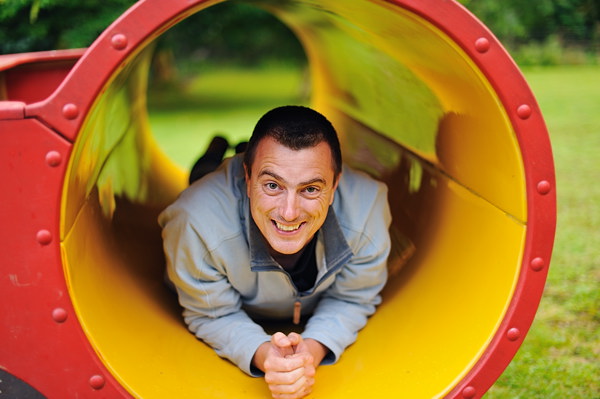
This holiday, my daughter was sent on a mission by her mother: get a picture of Dad on holiday for once.  Prove that he was here.  She took this up with some enthusiasm and between Mum’s camera phone, and her iPod she did well.

One evening I took the D700 to the playground to get some overall pics of the place in which we were staying for the holiday album.  Daughter Number One asked to use my camera for her Mission.  I set it to ‘Professional’ mode, auto iso, auto focus, auto focus point selection, auto white balance.  I hung my big, expensive camera around her 9 year old neck and I told her which button to press.

Amongst them is a shot which I might well have taken myself:

Rob Lamb, Professional Photographer
Rob Lamb, Professional Photographer (and Dad)